

The National Brain Appeal
WooCommerce to Shopify migration for the NHS charity behind the National Hospital for Neurology and Neurosurgery, so A Letter in Mind’s launch-day rush sells out without the shop going down.
Background
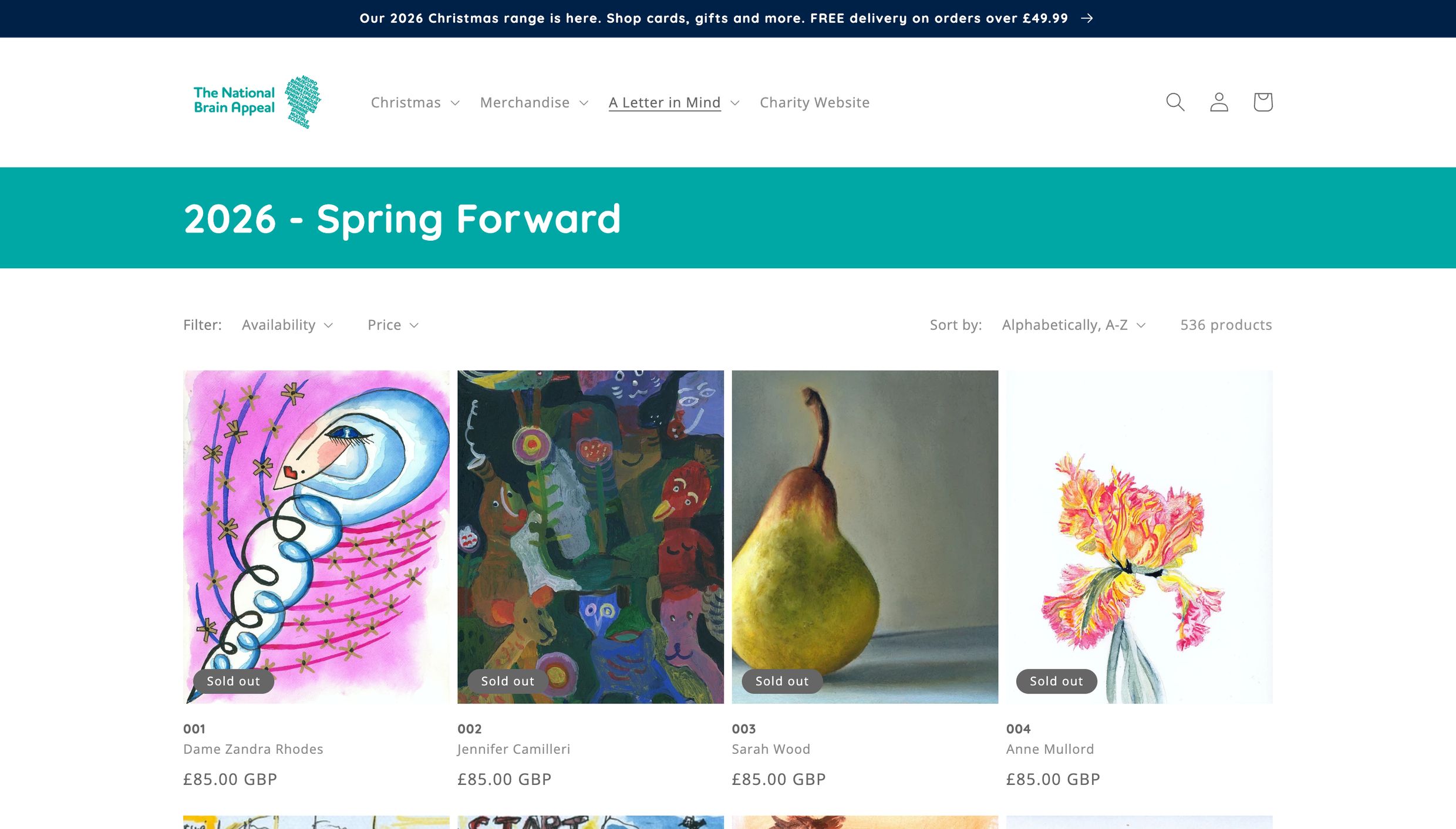
The National Brain Appeal is the charity for the National Hospital for Neurology and Neurosurgery in London, part of the NHS. Its biggest fundraising shop event is A Letter in Mind, an annual art sale: several hundred artists, from household names to first-timers, each produce an original work on an envelope-sized canvas to that year’s theme. Every piece sells at the same price and the artist is only revealed once it has sold, so everything goes on sale at once and most of it is gone within hours. The shop that ran it sat inside the charity’s WordPress site on WooCommerce, and launch day took it down. We migrated the shop to Shopify on its own subdomain, moved every year’s catalogue across, built the reveal into the platform, and handed the charity’s own team a launch they run themselves. The 2022 sale was the first on the new shop, and 2026 is the fifth.

We wanted to make the transition from our old WooCommerce shop to a faster Shopify platform. This meant a lot of old data needed to be migrated and reorganised. It was a job with quite a few unusual bespoke aspects, but Alex and team dealt with it all in their stride and we have ended up with a working shop that coped really well with an avalanche of sales on launch day.
The results
100%
uptime on launch day
8 minutes
to sell what took three hours the year before
80%
faster product page load time
Zero
customer complaints during the event
The solution
Why Shopify, and why a subdomain
- The charity’s content, campaigns and donations live on a large WordPress site that the team know well, so we recommended moving only the shop and leaving the rest where it was
- Set up Shopify on its own subdomain, so a launch-day rush lands on a platform built to absorb it and never touches the main site
Catalogue migration
- Exported the WooCommerce catalogue and brought every year’s unsold work across, back to the first sale in 2015, so previous collections stay on sale
- A tag per year drives a collection for each sale, named after its theme, plus a best-of collection of unsold work for the home page
- Cleaned up what came across: titles trimmed, item numbers made consistent, and the menu linking straight to in-stock views so a shopper never lands on a wall of sold work
- Redirected the old WooCommerce shop URLs to the new subdomain with one rule, so links in old emails and social posts still work
The reveal
- The artist’s name, the dimensions and the medium live in metafields on each product, shown on the product page and in the collection grid
- The artist’s name only appears when the piece has sold: the metafield is populated and the stock is zero. Until then a buyer sees the work, the number and the price
- The team import the artists’ names once, before the sale, and each artist’s name appears the moment their piece sells, with no data entry on the day
Launch-day release
- Wrote the release as a plan the team run from the Shopify admin and a spreadsheet: import the year’s pieces as drafts on a preview template with no buy button, open a browse-only preview the day before, then switch the template and make the collection live at the designated time
- Bulk imports through Matrixify: 700 pieces with images in about an hour, and a change across all of them in about a quarter of that
- A holding message in the announcement bar covers the last two hours before the sale opens, so nobody sees a half-built page
- No developer on the day. The charity has run every sale since 2022 the same way
Checkout and payments
- Moved payments to Shopify Payments, which brought Apple Pay, Google Pay and Shop Pay to a checkout that had never managed them on WooCommerce
Delivery and donations
- Set up three delivery zones, UK special delivery, Europe and rest of the world, each named as the customer sees it at the checkout
- Switched on tipping at the checkout as a donation to the charity, which brought in more donations than the previous year
Handover and training
- Trained the team to process orders, import products and run the release before the soft launch, then placed an order end to end with them
- Soft-launched on a Monday in October 2022 with the back catalogue, three weeks before the sale, so the first real orders arrived on a quiet day
Beyond the event
- With the shop on its own platform the charity has grown it beyond A Letter in Mind into Christmas cards, gift wrap and merchandise, with a free-delivery threshold
More Shopify case studies
B2C Shopify Plus replatform with product configurators and integrations to RetailSystem, ShipperHQ, Doofinder and Klaviyo.
Bed Factory Direct
Multi-site, B2C migration from Magento to Shopify Plus with ERP integration
Alan Paine
Shopify Plus integration with Aptean's Prima Solutions for this multi-channel brand.
Weekend Offender
B2B Shopify support and development, with SAP Business One integration advice.
BoxMart

Contact us if you are looking to:
- Improve the sales on your existing eCommerce site
- Get fresh, innovative ideas given to you on a regular basis
- Get qualified advice about eCommerce platforms
- Migrate between platforms
- Integrate your online store with another system

Partner with us to grow your business, using our real world experience as an eCommerce retailer.
Powered by Retail Success